Your Body Is Talking. Are You Listening?
There's a form of intelligence your wearable can't track. It lives in the space between heartbeat and thought — and after fifty, it quietly starts to fade. The good news: two weeks is all it takes to bring it back.
I've been wearing a health tracker for quite a while. I know my resting heart rate, my HRV, my sleep stages, my step count, my oxygen saturation. I can tell you what my body did last Tuesday at 2am with more precision than I could tell you what I was thinking.
And yet.
There are mornings when I sit down with my coffee and realise I haven't checked in with my actual body once. Not the data. The body. The slight tension across the shoulders that was there before I opened the laptop. The low-grade fatigue that the readiness score rated as "good." The quiet signal that something is off, before I can name what.
The wearable missed it. I missed it too.
The Signal That Gets Quieter With Age
Researchers call it interoception — the ability to perceive what's happening inside your body. Not from the outside in, through a sensor on your wrist, but from the inside out. Heartbeat, hunger, fatigue, emotion, tension, the felt sense that your body is trying to tell you something before you consciously know what it is.
It's a real, measurable faculty. And it does something counterintuitive as we age.
A 2024 study published in PubMed identified a gap that turns out to be surprisingly common after fifty: interoceptive accuracy — how precisely people actually perceive their internal signals — declines with age. But interoceptive sensibility — the belief that you know your body well — often increases. In other words: older adults tend to feel more confident about reading their internal signals, even as the accuracy of those readings quietly drops.
The gap matters. Poor interoceptive accuracy correlates with reduced emotional regulation and accelerated cognitive decline (ScienceDirect, 2025). The body is sending signals; the receiver is losing sensitivity.
This isn't inevitable. But it is something that needs to be actively maintained — and almost no one is talking about it.
What Marcus Aurelius Knew Before the Research Did
In Meditations, Marcus Aurelius returns again and again to a practice he calls self-examination. Not self-criticism. Examination. He describes the rational soul as one that has "self-awareness, self-examination, and self-determination" — three capacities that he considered the foundation of everything else.
What strikes me about this framing is the sequence. Awareness first. Not action. Not decision. Awareness.
Epictetus adds precision: the Stoic practice begins with learning to distinguish between impressions — the raw signals the body and mind send — and judgements about those impressions. Most people skip the first step entirely and live inside the second. We react to our interpretations of what we're feeling, often without ever pausing to feel what we're actually feeling.
Modern neuroscience has a name for the region responsible for this kind of awareness: the anterior insula. It integrates internal body signals with emotional context. And it turns out to be directly trainable — not through effort or analysis, but through a specific kind of attention.
The Stoics were, without knowing it, doing exactly that.
What the Research Actually Shows
A 2025 meta-analysis in Nature Scientific Reports looked at mindfulness-based programmes and their effect on interoceptive awareness across multiple studies. The finding: significant, measurable improvement (effect size g = 0.41, p < 0.001). The strongest effects came from body-focused practices — particularly the body scan.
More specifically: researchers at the University of Wiley found that just two weeks of regular body scan practice produced measurable improvements in interoceptive awareness (Schwerdtfeger, Applied Psychology, 2025). Not months. Not years. Two weeks.
This sits in an interesting place alongside the broader research on healthspan trajectories. A large study tracking over 700,000 adults across five decades found that by fifty, the trajectory of your functional health is already visible — not in your bloodwork or your lab results, but in your movement quality, your reaction speed, and your functional reserve. The leading indicators aren't numbers. They're capacities. The capacity to feel what's happening. To respond before the problem becomes a diagnosis.
Interoception is one of those capacities.
Getting Weirder — and Truer
There's a thread running through this that I find genuinely encouraging.
Rebecca Schlegel, a psychologist at Texas A&M, studies what she calls the "true self" — the sense of authentic identity beneath the roles we perform. Her research finds something surprising: people become more authentically themselves with age. Less concerned with how they appear to others. More oriented inward. What she describes, with affection, as "getting weirder" — in the best possible sense.
The connection to interoception is direct. Listening to the body — learning to trust the signals that come from the inside — is part of the same movement as learning to trust who you actually are beneath the persona. The wearable tells you what happened. The body, attended to carefully, tells you what's happening now, before it becomes data.
The second half of life offers a particular kind of permission: to stop optimising for external readouts and start listening to internal ones. The Stoics called this turning inward ataraxia — equanimity. Schlegel's participants called it getting comfortable being odd.
Both descriptions point to the same thing: knowing yourself from the inside.
The Practice
Five minutes. No screen. Just the body.
Sit or lie down comfortably. Close your eyes. Start at the top of your head — not looking for anything, not trying to fix anything. Simply noticing.
Move slowly downward. Scalp. Forehead. Jaw (usually clenched). Neck. Shoulders (almost always something here). Chest. Stomach. Lower back. Hips. Thighs. Knees. Calves. Feet.
For each area: pause. Notice what's there without naming it as good or bad. Tension, warmth, numbness, nothing — all are information. Let the scan be curious, not corrective.
When you reach the feet, pause for a breath. Then ask one question: what is my body trying to tell me that I haven't stopped to hear today?
You don't need to answer it. You just need to ask it.
Two weeks of this — five minutes, most days — and the research says your interoceptive accuracy will improve measurably. The channel opens. The signal gets clearer.
The body has been talking all along. This is how you start listening.
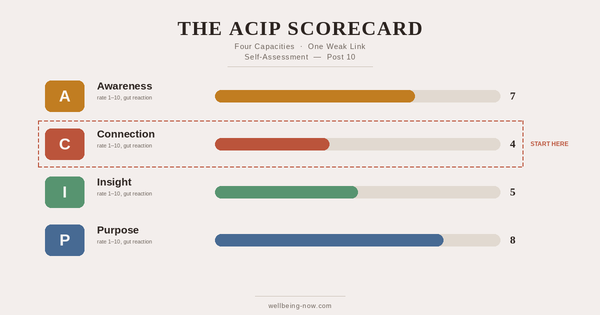
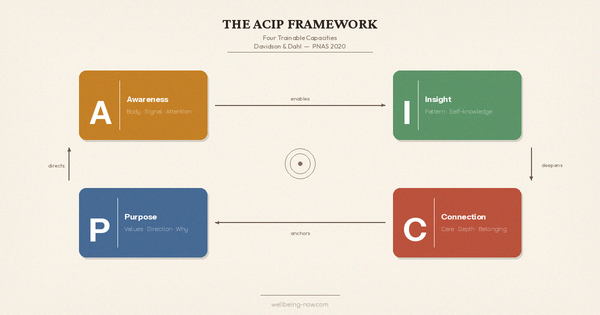
This is one of four capacities that turn out to work as a system — see The Four Capacities That Change Everything After Fifty