Why Your Mindset Ages Faster Than Your Body
A research team in New Zealand built a speedometer for aging. Here's what it measures — and why your sense of purpose is the dial.
Purpose. You've heard it so many times it stopped meaning anything. Then a research team in New Zealand built a speedometer — and suddenly it means everything.
For years, purpose was the word that wouldn't leave the room. Every keynote, every self-help shelf, every LinkedIn post about "living with intention." I reached a point where I stopped listening. It felt like advice that had been polished smooth — true in some abstract way, but too worn to grip.
Then I came across a piece of research that reframed it completely. Not as philosophy. Not as motivation. As a biological rate.
It turns out your sense of purpose has a speedometer. And it doesn't belong in your car.
The Speedometer That Measures You
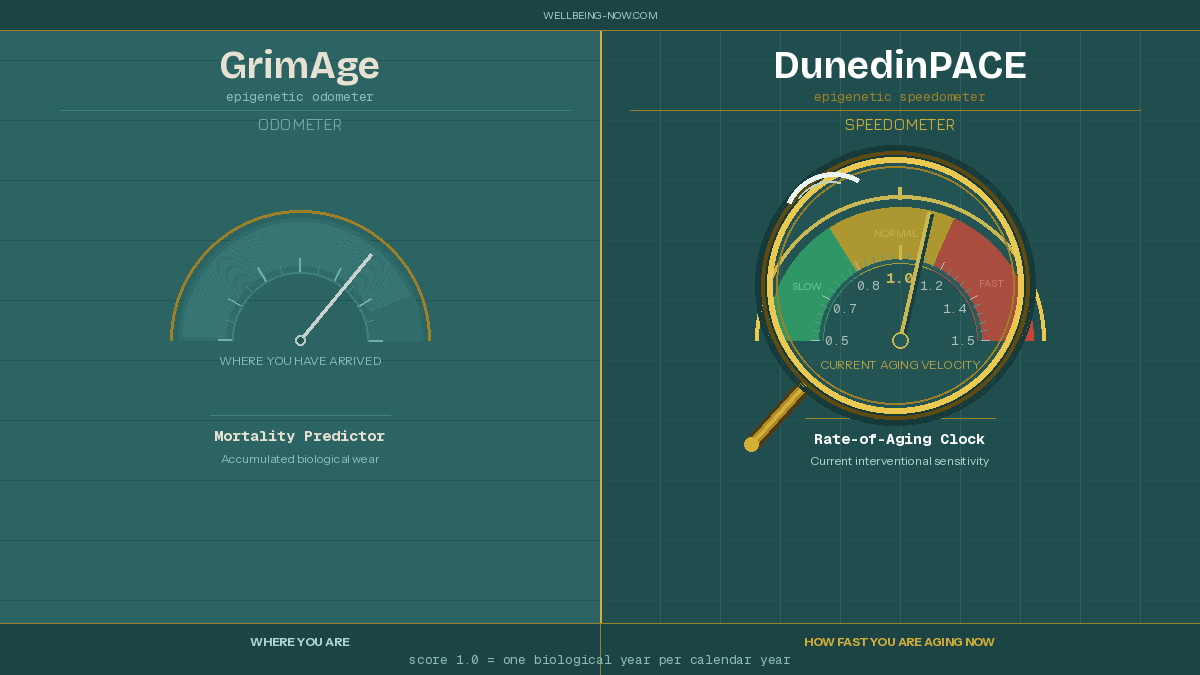
Researchers at Duke University and the University of Otago developed an epigenetic clock called DunedinPACE. It doesn't measure how old your cells are — there's already a clock for that, called GrimAge, which functions like an odometer: it shows you where you've arrived biologically.
DunedinPACE does something different. It measures how fast you are currently aging. Not where you are — how quickly you're getting there.
If GrimAge is the odometer, DunedinPACE is the speedometer.
A score of 1.0 means you're aging at exactly one biological year per calendar year. Below 1.0, slower. Above 1.0, faster. It's sensitive enough to detect whether lifestyle changes are actually working at the cellular level — which makes it, right now, one of the most useful tools in longevity medicine.
What drives the speedometer up? Chronic stress. Inflammation. Social isolation. A loss of direction.
What slows it down? The usual suspects — sleep, movement, diet. But increasingly, research points to something less measurable: a sense that what you're doing matters.
The Numbers Behind Purpose
Researchers at UC Davis followed more than 13,000 adults aged 45 and above for up to fifteen years. Their finding, published in 2025: people with a strong sense of purpose were 28% less likely to develop cognitive impairment. The effect held across racial and ethnic groups, and — remarkably — even among those carrying the APOE4 gene, the most significant known genetic risk factor for Alzheimer's disease.
Purpose wasn't masking the risk. It was genuinely buffering against it.
Other research adds texture to the picture. High-purpose individuals show walking speeds and grip strength equivalent to someone 2.5 years younger. They have a 36% lower dementia risk in some cohorts, and a 40% lower overall mortality risk. These are not small effects dressed up as findings — they're robust signals across large populations and long time horizons.
Purpose isn't a feeling. It turns out to be a measurable biological state.
What Brooks Gets Right
Arthur C. Brooks published The Meaning of Your Life in March 2026 — and it arrives at exactly the right moment for anyone navigating the second half.
His central argument: the same drives that made us successful in the first act — status, achievement, external validation — become the source of emptiness in the second. Not because they were wrong, but because they have a natural ceiling. The external scoreboard eventually stops updating. And when it does, the people who never built an internal one are left with nothing to read.
Brooks calls this the shift from success to significance. From proving yourself to contributing yourself.
What strikes me about this framing is how closely it maps onto Epictetus — who drew a hard line between what is up to us and what is not. Status, recognition, the opinions of others: not up to us. Our values, our attention, our chosen commitments: entirely up to us.
The Stoics were describing, in philosophical language, what modern research now confirms in biological terms: that meaning derived from external sources is fragile. Meaning anchored to something internal and chosen is not.
The Invisible Audit
There's a version of the Stoic daily review — what Marcus Aurelius practiced in his Meditations — that I've been running for a few months now. After the usual questions (what went well, what didn't), I ask two more:
What did I do today that I would have done even without an audience?
What would I have spent more time on, if I hadn't been waiting for it to feel justified?
These aren't feel-good prompts. They're diagnostic. They surface the gap between how I actually spend my time and what I actually value — which turns out to be a more useful signal than step count or HRV.
DunedinPACE is measuring something real at the cellular level. But long before the biology shifts, the mind gives us an earlier warning. Stagnation, boredom, the subtle restlessness of a life organized around the wrong things — these are the leading indicators.
The watch can't detect them. The evening review can.
The Practice
Tonight, take five minutes with a pen and paper — not a screen.
Write down one thing you did today that had no external return. No praise, no professional value, no metrics. Something you did because it mattered to you, quietly, regardless of audience.
If you can't think of one, that's the answer.
Then ask: what would tomorrow look like if that thing got thirty more minutes?
That's not a productivity question. It's a biological one.
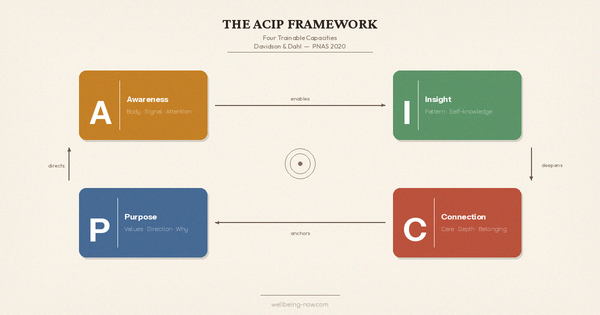
This is one of four capacities that turn out to work as a system — see The Four Capacities That Change Everything After Fifty