The Four Capacities That Change Everything After Fifty
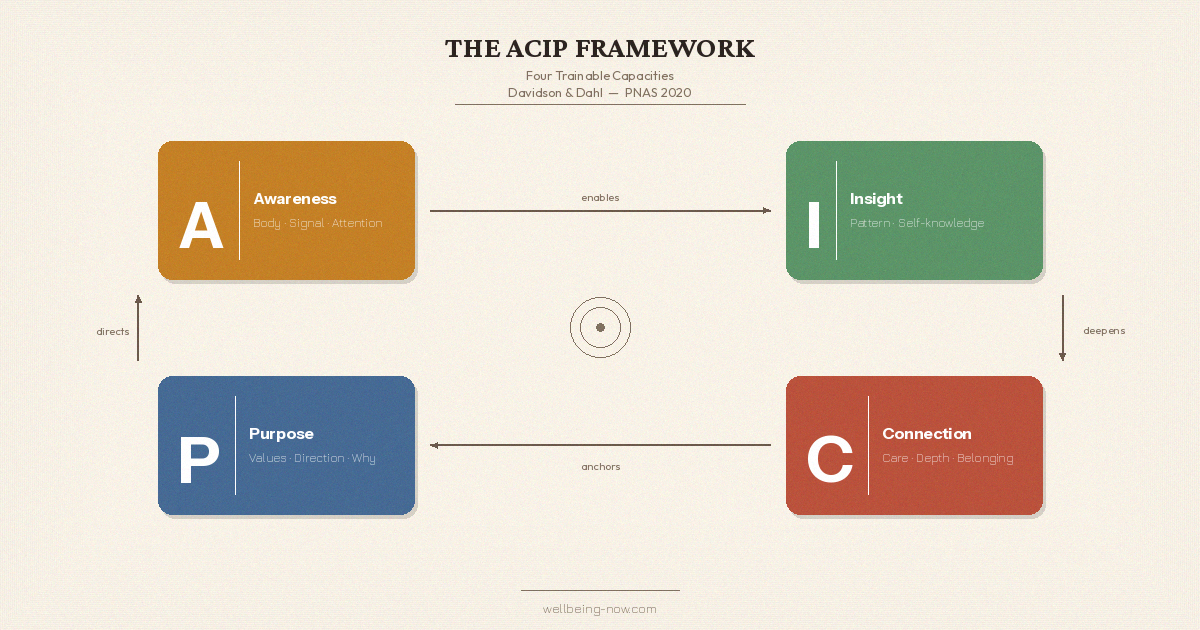
Eight posts into this series, I made an unexpected discovery. A neuroscientist at the University of Wisconsin had already named what I was building.
I've been working on four things for the better part of a year. Learning to listen to my body before it shouts. Tending to the few relationships that actually matter. Catching myself in the automatic patterns I've been running for decades. And staying honest about what I'm actually for — not what I used to be for.
I hadn't called this a framework. It felt more like noticing — a slow accumulation of things I kept coming back to.
Then I found a paper. In December 2020, Cortland Dahl, Christine Wilson-Mendenhall, and Richard Davidson published "The Plasticity of Well-Being: A Training-Based Framework for the Cultivation of Human Flourishing" in the Proceedings of the National Academy of Sciences. Their central claim — backed by decades of neuroscience — was deceptively simple: wellbeing is a skill. Not a trait you're born with. Not an outcome you achieve. A skill, composed of four trainable capacities. They called it awareness, connection, insight, and purpose.
I had been calling it ACIP. Turns out I was in good company.
The Four Capacities
Most wellbeing advice tells you what to do. Davidson and Dahl's framework asks a different question: what are you capable of developing? A list of tips is passive consumption. A framework is architecture — something you inhabit and build out over time.
Here's how the research defines each capacity, and where it showed up in this series.
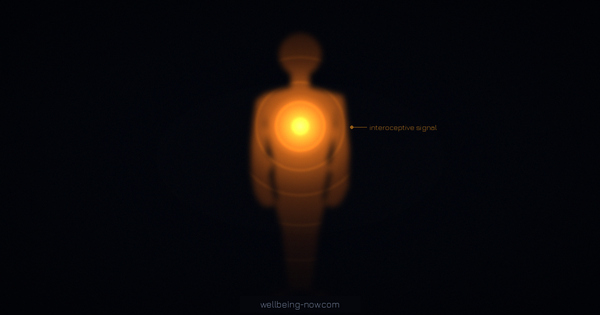
Awareness is the ability to direct and sustain attention — on tasks, on others, and on the internal signals your body is constantly sending. The research I found for Post 8 revealed a counterintuitive pattern: after fifty, interoceptive accuracy (how precisely we read our body's signals) tends to decline, while our confidence in reading those signals increases. We feel more certain while becoming less right. The good news: two weeks of consistent body scan practice produces measurable improvement. Awareness is the fastest capacity to move — and the foundation everything else rests on.
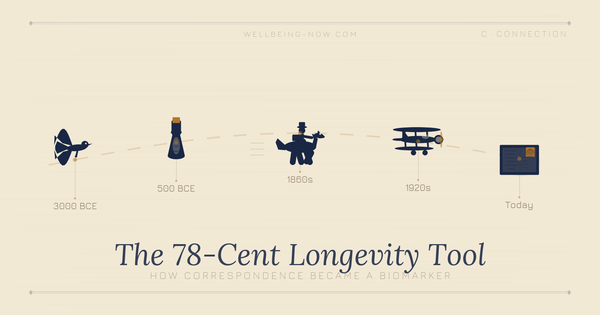
Connection is the feeling of genuine care and belonging — the relational quality that turns out to be one of the most robust predictors of health in the entire research literature. The Harvard Study of Adult Development, which tracked adults for over eighty years, found that the quality of relationships at age fifty matters more than cholesterol levels for health at eighty. That's what Post 6 was about: not network size, but relational depth. The 78-cent postcard as a small but intentional act of maintenance.
Insight is self-knowledge — specifically, understanding how your emotions, beliefs, and habitual patterns shape what you experience and how you respond. Post 5 explored the gap between an impression (what happens) and your assent to it (what you make it mean). Roughly 65% of everyday behaviour runs on autopilot. Insight is the capacity that lets you notice the autopilot before it decides.
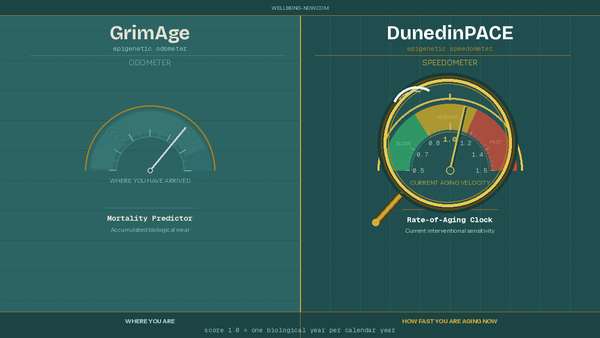
Purpose is clarity about what you're actually for — and the ability to let that clarity shape your daily choices, not just your identity. The research here is striking: a UC Davis study tracking over 13,000 adults for fifteen years found that a strong sense of purpose correlates with a 36% lower risk of dementia, and with the physical markers of someone 2.5 years younger. Post 7 explored how purpose isn't a fixed destination but a velocity — and how that velocity is measurable.
A System, Not a List
Here's what most frameworks miss: these four capacities don't operate in isolation. They form a loop.
You can only examine what you first notice — Awareness feeds Insight. Genuine self-knowledge changes how you show up in relationships — Insight enables real Connection. And Purpose, as Arthur C. Brooks put it recently, can't rest on you alone: it needs the anchor of real connection to become something more than ambition. Purpose then directs what you pay attention to. Which returns you to Awareness.
Most people over-invest in one capacity and quietly neglect the others. Awareness without Purpose is clarity without direction. Purpose without Insight tends to repeat old patterns — faster, and with more force behind them. Connection without Awareness produces presence in body and absence in mind.
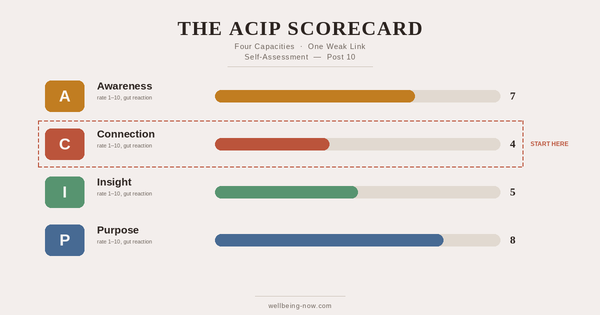
The place to start isn't the beginning of the list. It's the weakest link in your specific loop. (Which, if you're honest with yourself, you probably already know.)
The Stoic Software
Marcus Aurelius described the rational soul as having "self-awareness, self-examination, and self-determination" — that's A, I, and P in one sentence. The Stoics also held a fourth principle: Sympatheia, the awareness of our fundamental connectedness to each other. That's C.
Pierre Hadot, who spent decades studying how the Stoics actually practised philosophy (as opposed to merely talked about it), mapped these to four disciplines:
- Prosoche — the discipline of attention → Awareness
- Synkatathesis — the discipline of judgement → Insight
- Kathekon — purposeful, virtuous action → Purpose
- Sympatheia — belonging to the larger whole → Connection
Davidson and Dahl published their framework in 2020. Marcus Aurelius was writing his version around 170 CE.
Some frameworks survive because they're pointing at something real.
What Gets Better
There's a cultural story about aging that treats biological functions as the whole story — grip strength, VO2 max, processing speed, all trending in one direction. The message, stated or implied: your best years are behind you. Adjust accordingly.
The ACIP capacities don't follow this curve. Interoceptive awareness is trainable in weeks. Purpose often clarifies after fifty — what Brooks calls the shift from striver to sage, from competing to contributing. Rebecca Schlegel's research at Texas A&M shows that people become more authentically themselves with age: less concerned with external performance, more oriented inward.
These capacities don't peak in your thirties. In some ways, the second half of life creates exactly the conditions to build them. You've earned enough self-knowledge to make Insight real. Your Connection has fewer but deeper roots. Purpose has had decades to clarify what it isn't.
The Practice: An Evening Audit
In the spirit of Epictetus — who was more interested in what you did than what you believed — four questions for tonight:
Awareness: What has my body been trying to tell me today that I haven't stopped to hear?
Connection: Did I have a genuine moment of contact with another person — or just proximity?
Insight: What pattern did I catch myself running today, and what did I do with it?
Purpose: Did what I did today reflect what I actually care about?
You don't need to answer all four well. Take each one seriously.
And if one made you uncomfortable — that's probably the one worth sitting with tonight.
The Research Behind This Post
This post draws on the following sources. The individual capacities are explored in depth in Posts 5–8.
Scientific Foundation
- Dahl, Wilson-Mendenhall & Davidson (2020). "The Plasticity of Well-Being." PNAS Vol. 117, No. 51. → PMC Open Access
- Center for Healthy Minds, UW-Madison → The Healthy Minds Framework
- The Healthy Minds Program App (built on the Davidson/Dahl framework) → hminnovations.org
Awareness (Post 8)
- Schwerdtfeger (2025). Two-week body scan & interoceptive awareness. Applied Psychology → Wiley
- Meta-analysis: Mindfulness & interoception (g=0.41). Nature Scientific Reports 2025 → Nature
Connection (Post 6)
- Harvard Study of Adult Development → Harvard Gazette
Insight (Post 5)
- University of South Carolina (2025): 65% of daily behaviour is automatic → USC
Purpose (Post 7)
- UC Davis (2025): Purpose & dementia risk, 13,000+ participants, 15 years → UC Davis Health
In This Series
- Post 5 — Insight: Catching Yourself in the Act
- Post 6 — Connection: The 78-Cent Longevity Tool
- Post 7 — Purpose: Why Your Mindset Ages Faster Than Your Body
- Post 8 — Awareness: Your Body Is Talking. Are You Listening?