Insight: The Art of Catching Yourself in the Act
There's a version of self-reflection that feels productive but isn't.
I discovered mine on a Tuesday evening here in my Thailand, not long into my sabbatical. I was doing what I'd been doing regularly for some time — sitting with a notebook, reviewing the day. What went well. What didn't. Where I was patient, where I wasn't. The kind of structured self-examination the Stoics called the evening review.
It felt rigorous. It felt honest.
But somewhere around week six, I noticed something uncomfortable: I was writing the same entries. Different days, same patterns. The same frustration when plans changed. The same low-grade restlessness after long stretches of solitude. The same slight defensiveness when someone questioned my ideas.
I was auditing what happened. I wasn't understanding why it kept happening.
The Gap Between Noticing and Understanding
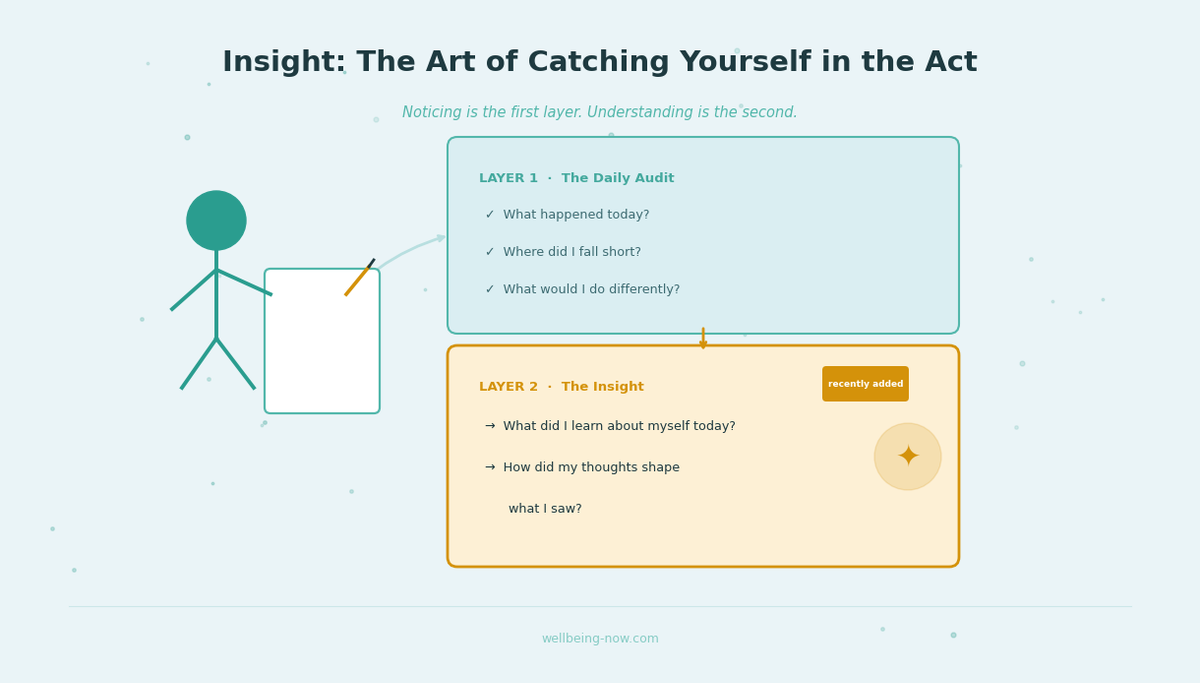
The Stoic Daily Audit is a powerful practice. At the end of each day, you ask: Did I act in alignment with my values? Where did I fall short? What would I do differently?
It's a practice of accountability — and that matters. But accountability without insight is just a performance review with no root cause analysis.
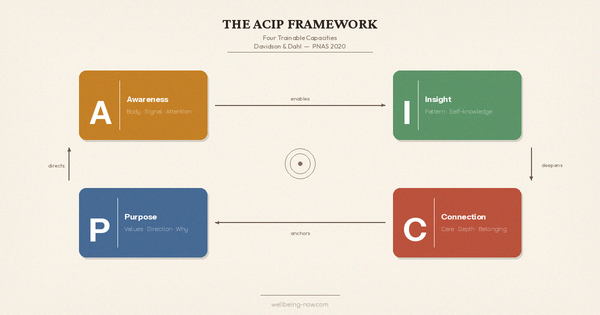
When I came across the work of Richard Davidson and Cortland Dahl — researchers at the Center for Healthy Minds at the University of Wisconsin-Madison — it put words to something I'd been dimly sensing. They describe insight as something distinct: the capacity to see how our thoughts, emotions, and beliefs actively shape the way we perceive ourselves and the world. Not just what we did — but how our internal lens determined what we saw, and therefore what we did.
The difference is subtle but significant.
Accountability asks: Did I react too quickly in that conversation?
Insight asks: What belief made that feel threatening in the first place?
One closes the loop. The other opens it.
What My Evening Reviews Were Missing
Going back to that notebook: I had pages of observations about behaviour. Almost nothing about the architecture underneath it.
When I wrote "felt restless after a long day alone", I wasn't asking why solitude sometimes felt like deprivation rather than restoration. When I wrote "got defensive when questioned", I wasn't exploring what it was about my identity that made challenge feel like attack.
I was cataloguing symptoms. I hadn't yet started diagnosing the system.
The shift is recent. I've started adding a second layer to the Stoic review — not replacing the accountability questions, but following them with a different kind of question entirely:
How did my thoughts and feelings shape the way I saw what happened today?
That question changed everything. It moved me from judge to investigator. And it started surfacing patterns that the performance-review version of self-reflection had been quietly obscuring for years.
Insight in the PERMAH Framework
In PERMAH terms, insight lives primarily in Meaning and Accomplishment — but it influences everything.
When we understand the internal filters through which we interpret experience, we stop being reactive participants in our own lives and start becoming, as Davidson and Dahl put it, active architects of our experience.
That's not a small shift. I spent 35 years measuring myself against external targets — projects delivered, budgets met, outcomes tracked. Switching to questions about my internal architecture doesn't come naturally. But for Modern Elders navigating the transition from structured career to the more open terrain of the second half, it may be the most important shift available.
The question "what did I achieve today?" has limited reach when you're no longer measuring yourself against quarterly targets. The question "how did my beliefs shape what I experienced today?" has no ceiling.
The Practice: A 5-Minute Self-Inquiry Journal
I'll admit, I resisted adding anything to an already established practice. But this isn't about lengthy introspection or therapeutic excavation. It's small — five minutes, two questions.
Step 1: Do your usual Daily Audit. What happened. Where you acted in alignment, where you didn't.
Step 2: Add the Insight layer. Take two minutes and answer, in writing:
What did I learn about myself today?
How did my thoughts and feelings shape the way I saw things?
The instruction from Davidson and Dahl is important here: use curiosity rather than judgment. You are not prosecuting yourself. You are investigating — with the same dispassionate interest a scientist brings to unexpected data.
Some days the answer is mundane. Other days, a sentence will surface that stops you cold — a belief you'd been carrying without realising it was a choice.
Those are the moments. That's the insight.
The Audit Becomes Architecture
I won't pretend I've been doing this for long. The insight layer is new — a few weeks in, still finding its shape. I'm still writing some of the same entries.
But something has already shifted. I'm starting to see the pattern behind the pattern — not just what I wrote, but why I keep arriving at the same place. Structural tendencies, not personal failings. Beliefs that have been running quietly in the background, longer than I'd like to admit.
They're not yet fully visible. But they're becoming visible. And that, I'm learning, is where the real work begins.
The Stoic tradition understood this. Marcus Aurelius didn't just record what happened in his Meditations — he interrogated the assumptions underneath his reactions, relentlessly and without self-pity. What he called mastery of the inner citadel begins with actually knowing what's inside it.
The evening audit is the door. Insight is what you find when you stop standing in the doorway.
The Practice:
Tonight, after your usual reflection, take five minutes and ask yourself two questions — not to judge, but to understand:
What did I learn about myself today?
How did my thoughts shape the way I saw things?
Write one honest sentence in answer to each. That's enough to start.
PERMAH Anchor: Meaning (M) + Accomplishment (A)
Slug: insight-the-art-of-catching-yourself-in-the-act
Tags: insight, stoicism, daily-audit, PERMAH, self-reflection, practice
This is one of four capacities that turn out to work as a system — see The Four Capacities That Change Everything After Fifty