WHAT MY WATCH CAN'T TELL ME
I've been wearing an Apple Watch for years. It tracks my steps, my sleep, my stress. It knows a lot about me. But the night I finally slept well — it had nothing to do with the data.
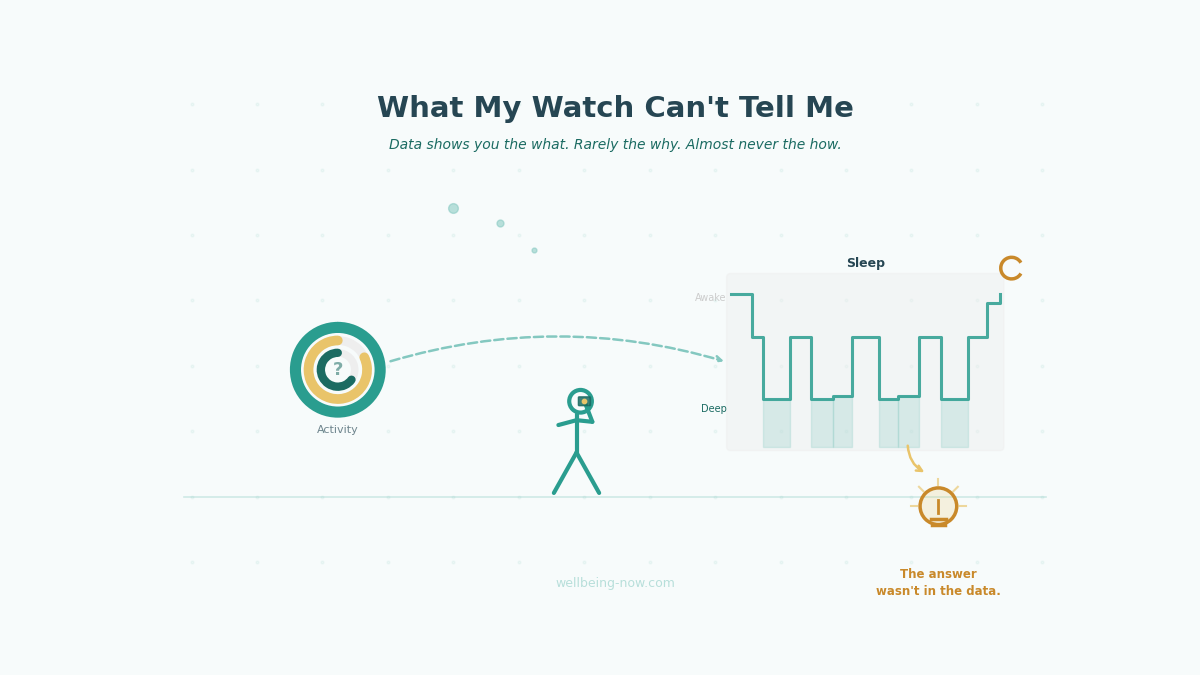
There's a moment I know well. I glance at my wrist, see the three activity rings — and feel a small, complicated mix of satisfaction and guilt. Or sometimes: mild irritation, followed immediately by the quiet pull of wanting to close the damn rings anyway.
That's the relationship. It's been going on for years.
The Ring and I
At some point, I turned off the notifications. The little buzz every hour reminding me to move — gone. I didn't need a wristband nagging me like a personal trainer I never hired. I'm a grown man. I know when I need to walk.
And yet. By evening, I'd check the rings. And if they were closed, I felt good. Genuinely good — the small, warm glow of something accomplished. Which made me wonder: am I exercising for myself, or for the watch?
The honest answer is: both. And I've made my peace with that. The watch doesn't make me active. But it holds up a mirror, and I happen to respond well to mirrors. Not everyone does. That's worth knowing about yourself.
The Night I Decided to Track My Sleep
My sleep has always been patchy. I wake up frequently — sometimes three, four times. The usual reason, the usual age. On most mornings I feel functional. On some, I feel genuinely restored — those rare nights when I stayed asleep longer, the body going deep without interruption. Those mornings, the difference in energy is unmistakable.
So I made a decision: I'd wear the watch to bed. I'd see what was actually happening. Understanding the pattern, I thought, would give me something to work with.
I did it. On and off. More off than on, if I'm honest — the watch felt strange on my wrist at night, and some nights I simply forgot. But when I did track, the data was clear.
It showed me exactly what I already felt.
Poor fragmentation, short deep sleep phases, the occasional better night standing out like a small blue island in a grey chart. Nothing I didn't already know. Nothing actionable that I hadn't already tried.
I stared at the graphs. I read the recovery scores. I felt, strangely, worse for it — like being handed a detailed report on something you already know is broken, with no repair manual attached.
The Solution the Watch Couldn't Offer
What actually helped didn't come from a dashboard.
A friend mentioned a natural supplement — nothing dramatic, something plant-based, easily available. I tried it, sceptically, the way you try things at this stage of life: without much expectation, half-hoping to be surprised. Within two weeks, the difference was real. Not perfect sleep. But longer, deeper stretches. Less waking. A better morning.
And the second thing? I stopped watching the next episode.
That sounds almost too simple. But that particular habit — one more episode, it's only 45 minutes — was reliably pushing my sleep window past midnight. Cutting it cost me nothing during the day and gave me something measurable at night.
Two changes. Neither required a fitness tracking watch.
What I've Learned About Data and Health
The watch is useful. I won't pretend otherwise. It quietly nudges me toward movement, and I respond to that nudge. But here's what I've come to understand:
Data shows you the what. It rarely shows you the why. And almost never the how.
The sleep data told me I was sleeping badly. It didn't tell me about the supplement. It didn't tell me about the episode I was watching at 11:30pm. Those answers came from paying attention to my life — not to my metrics.
In the PERMAH framework, Health is one of six dimensions of wellbeing. Not the most glamorous one, not the most philosophical. But the foundational one — the engine that makes everything else possible. And the framework defines it simply: building habits of eating, moving, sleeping, and resting that give you energy.
Not habits of measuring. Habits of living.
Will It Ever Be Resolved?
Probably not. That's my honest answer.
I'll keep wearing the watch. I'll keep checking the rings. I'll track sleep when I remember to, and I'll occasionally look at graphs I already understand in my body. And I'll keep experimenting — with supplements, with routines, with the discipline to stop the series before midnight.
The wearable is a tool. Like any tool, it's only as good as the question you bring to it.
The better question isn't what does the data say?
It's what do I already know — and what am I willing to do about it?
This post is part of my ongoing exploration of Longevity & Wearables 50+ — one of the five content pillars of wellbeing-now.com. Real data, honest reflection, no performance.