The Wellbeing Model That Changed How I Structure a Day
PERMAH isn't a wellness trend. It's a research-based framework that maps what a thriving human life actually consists of — and gives you a way to audit where you really are.
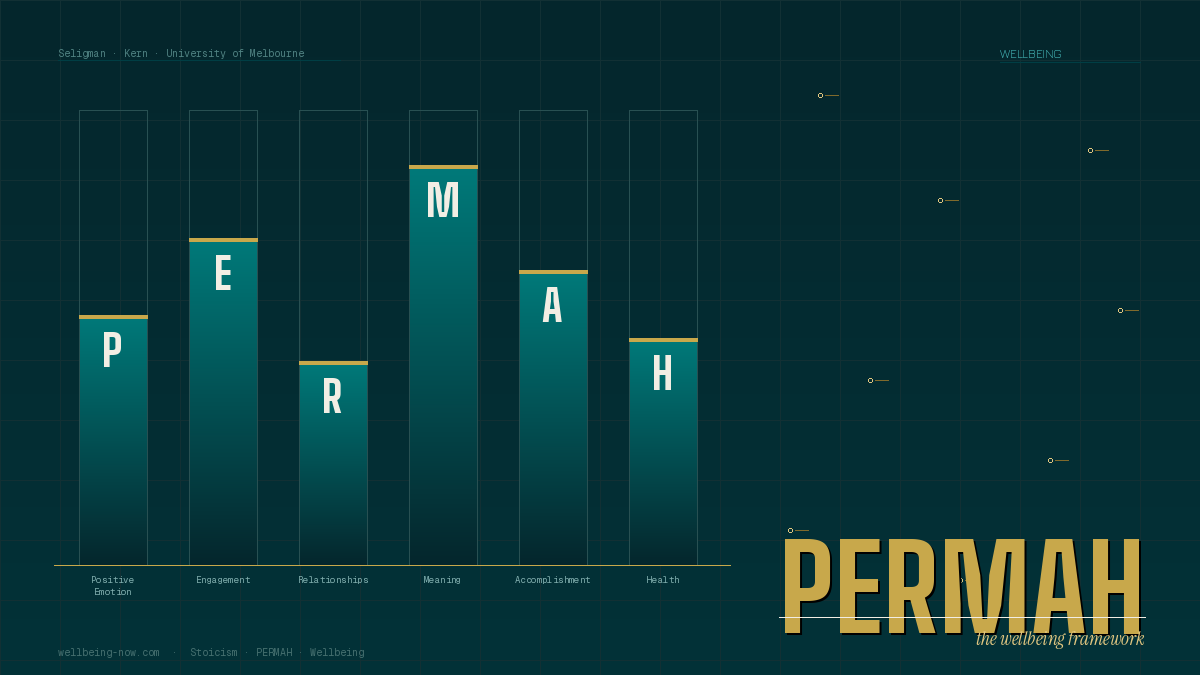
PERMAH: six dimensions, one coherent framework — and why it matters more at 50 than it did at 30
I spent years trying to optimise things that didn't matter while neglecting things that did.
Not because I was careless — I was professionally trained to optimise. I could build a project plan, map a system architecture, and define KPIs for almost anything. The problem was that 'wellbeing' didn't fit neatly into any of those templates. It was too fuzzy. Too personal. Too hard to measure.
Then I found PERMAH.
What PERMAH Actually Is
PERMAH is a framework from positive psychology, developed by Martin Seligman and extended by Margaret Kern at the University of Melbourne. It's not a self-help system. It's a structured attempt to map the dimensions of a genuinely thriving human life — based on decades of research across cultures, ages, and contexts.
The six dimensions are:
| Dimension | What it covers | |
|---|---|---|
| P | Positive Emotion | Joy, gratitude, serenity — actively cultivated, not just felt |
| E | Engagement | Flow states, strengths, absorbed attention |
| R | Relationships | Connection, quality of bonds, belonging |
| M | Meaning | Purpose, coherence, significance beyond yourself |
| A | Accomplishment | Mastery, goals, progress — pursued for their own sake |
| H | Health | Physical wellbeing as the foundation for everything else |
Why I Use It (Instead of Just Thinking About Wellbeing)
The temptation with wellbeing is to treat it as a general feeling. "I feel pretty good" or "I'm not quite right." Vague. Unmeasurable. And therefore, hard to act on.
PERMAH does something more useful: it gives you six distinct dimensions to examine separately. And when you do that, things become clearer.
Here's an honest example from my own audit a year ago: Engagement (flow) was high — I was doing intellectually interesting work. Accomplishment was high. But Relationships had quietly eroded. Most of my social contact was professional. Meaning had become almost entirely tied to work outcomes. And Health — specifically sleep — was a low-grade disaster I'd been ignoring.
Seen as a whole: 'things are fine.' Seen through PERMAH: two dimensions were genuinely depleted in ways that, left unaddressed, would compound.
The framework didn't tell me what to do. But it showed me where to look. That's most of the work.
PERMAH at 50-Something
The research on wellbeing across the lifespan shows something counterintuitive: average wellbeing tends to increase with age, not decrease. The so-called 'U-curve of happiness' bottoms out somewhere in the mid-forties and rises thereafter.
But this isn't automatic. It's not a gift of age — it's the result of a shift that some people make and others don't: from extrinsic to intrinsic drivers. From status and comparison to meaning and depth.
The dimensions that tend to matter more in the second half of life — Meaning, Relationships, Engagement with things that genuinely interest you — are precisely the ones that get squeezed by professional ambition in the first half.
PERMAH makes that rebalancing visible. And once visible, addressable.
What I'm Building Here
On wellbeing-now.com, I'm assembling a library of PERMAH-based exercises — one for each dimension, at various levels of depth. Not a programme. Not a subscription. A toolkit.
Some will take three minutes. Some will take a week. All are grounded in research rather than optimism — and tested against my own experience, with the scepticism that tends to come from having spent a career in systems analysis.
The first exercises are already here, free. The fuller library will follow.
But before any of that — try this:
Pick one of the six dimensions. Rate it honestly from 1 to 10 right now. Then ask: what would a 7 look like, specifically, in my actual life next Tuesday?
That specificity — Tuesday, not 'someday' — is where the real work starts.
→ Explore all six PERMAH dimensions on the PERMAH page
→ Download the free Wellbeing Reflection Workbook on the Resources page
→ Subscribe to follow the work — next post: what six months of wearables taught me about sleep